The number after a trillion is a quadrillion. A trillion has 12 zeros (1,000,000,000,000); a quadrillion has 15 zeros (1,000,000,000,000,000). After quadrillion comes quintillion, sextillion, septillion, octillion, nonillion, decillion, and so on — each step adds three zeros (in the short scale used in the US and modern UK).
Quick answers
- After trillion: quadrillion (15 zeros, 1015).
- After quadrillion: quintillion (18 zeros).
- After quintillion: sextillion (21 zeros).
- After sextillion: septillion (24 zeros), then octillion (27), nonillion (30), decillion (33).
- After decillion: undecillion (36 zeros), duodecillion (39), tredecillion (42).
- After tredecillion: quattuordecillion (45 zeros), then quindecillion (48).
- In money: $1 trillion is 1,000 billion dollars. The next unit, $1 quadrillion, is 1,000 trillion dollars. No country or company has ever held that much.
This guide lists every named number above a trillion, explains how the short and long scales differ, and breaks down the giants — googol, googolplex, Skewes’ number, and Graham’s number.
What comes after a trillion?
Pick a number name to see what follows it, how many zeros it has, and what it looks like written out.
These are short-scale names — the system used in Nigeria, the US and modern British English, where a billion is a thousand million. Some European countries use the long scale, where a billion means a million million.
Quick zero counts
- Million: 6 zeros
- Billion: 9 zeros
- Trillion: 12 zeros
- Quadrillion: 15 zeros
- Quintillion: 18 zeros
Short scale vs long scale
The “short scale” — used in the US, modern UK, and most English-speaking countries — adds three zeros per step: million → billion → trillion → quadrillion.
The “long scale” — still used in parts of Europe — adds six zeros per step. A long-scale “billion” equals a short-scale trillion.
| Power of ten | Zeros | Short scale (US/UK) | Long scale |
|---|---|---|---|
| 109 | 9 | billion | thousand million / milliard |
| 1012 | 12 | trillion | billion |
| 1015 | 15 | quadrillion | thousand billion |
| 1018 | 18 | quintillion | trillion |
| 1021 | 21 | sextillion | thousand trillion |
| 1024 | 24 | septillion | quadrillion |
| 1027 | 27 | octillion | thousand quadrillion |
| 1030 | 30 | nonillion | quintillion |
| 1033 | 33 | decillion | thousand quintillion |
| 1036 | 36 | undecillion | sextillion |
| 10100 | 100 | googol | googol |
| 10303 | 303 | centillion | — |
| 10600 | 600 | — | centillion |
| 10googol | googol | googolplex | googolplex |
What number comes after a trillion?
The number after a trillion is quadrillion: 1 followed by 15 zeros (1,000,000,000,000,000).
A trillion itself is 1 followed by 12 zeros — 1,000,000,000,000.
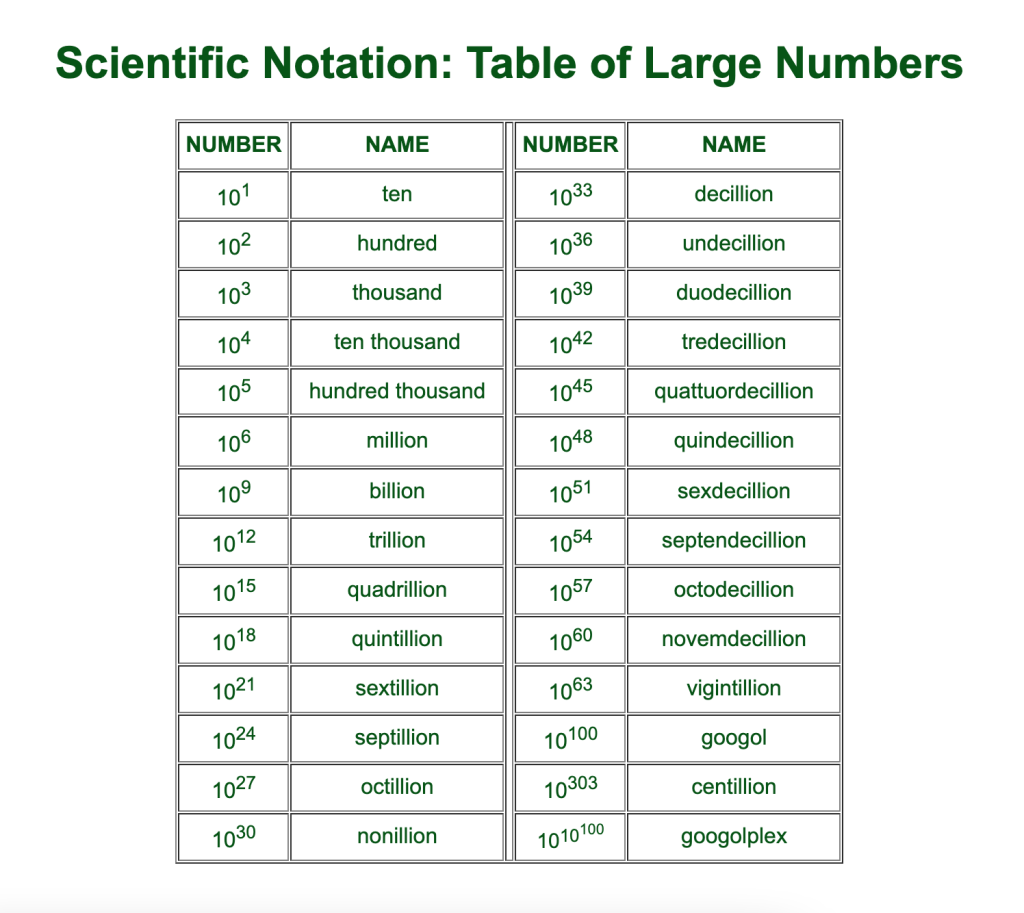
After that, every step adds three zeros and a new “-illion” name. Below is the full short-scale list up to a googol.
| Name | Zeros | Power of ten |
|---|---|---|
| Million | 6 | 106 |
| Billion | 9 | 109 |
| Trillion | 12 | 1012 |
| Quadrillion | 15 | 1015 |
| Quintillion | 18 | 1018 |
| Sextillion | 21 | 1021 |
| Septillion | 24 | 1024 |
| Octillion | 27 | 1027 |
| Nonillion | 30 | 1030 |
| Decillion | 33 | 1033 |
| Undecillion | 36 | 1036 |
| Duodecillion | 39 | 1039 |
| Tredecillion | 42 | 1042 |
| Quattuordecillion | 45 | 1045 |
| Quindecillion | 48 | 1048 |
| Sexdecillion | 51 | 1051 |
| Septendecillion | 54 | 1054 |
| Octodecillion | 57 | 1057 |
| Novemdecillion | 60 | 1060 |
| Vigintillion | 63 | 1063 |
| Unvigintillion | 66 | 1066 |
| Duovigintillion | 69 | 1069 |
| Trevigintillion | 72 | 1072 |
| Quattuorvigintillion | 75 | 1075 |
| Quinvigintillion | 78 | 1078 |
| Sexvigintillion | 81 | 1081 |
| Septenvigintillion | 84 | 1084 |
| Octovigintillion | 87 | 1087 |
| Nonvigintillion | 90 | 1090 |
| Trigintillion | 93 | 1093 |
| Untrigintillion | 96 | 1096 |
| Duotrigintillion | 99 | 1099 |
| Ten-duotrigintillion (Googol) | 100 | 10100 |
| Centillion | 303 | 10303 |
| Googolplex | a googol | 10googol |
After googol, the next big named landmarks are Skewes’ number (around 101034) and Graham’s number, which can’t be written in normal notation.
The word “zillion” is not a real number — it’s slang for “a lot”.
Understanding how big these numbers are
A trillion sounds small next to googol but it’s still huge. Counting one number per second, non-stop, would take about 31,709 years to reach a trillion.
A googol (10100) is bigger than the estimated number of atoms in the observable universe (about 1080). The mathematician Edward Kasner coined the name in 1920; his nine-year-old nephew, Milton Sirotta, made it up. Google the search engine took its name from this word.
A googolplex (10googol) is so large that you cannot write it out — there isn’t enough room in the observable universe for the digits, even at one digit per atom.
Skewes’ number was introduced in 1933 by South African mathematician Stanley Skewes as an upper bound in a problem about prime numbers. The first version was about 10101034. It was once called “the largest number that ever served a definite purpose in mathematics”.
Graham’s number, introduced by Ronald Graham in 1971, dwarfs all of the above. It cannot be expressed with ordinary exponents. It needs Knuth’s up-arrow notation. Even writing the number of digits would not fit in the universe.
FAQs
What’s after quadrillion?
Quintillion — 1 followed by 18 zeros (1018).
How many zeros does a googol have?
100 zeros. 1 followed by 100 zeros.
Is a zillion a real number?
No. “Zillion” is everyday slang for “a very big number”. It has no value.
What’s the largest named number?
Among numbers used in mathematical proofs, Graham’s number was for decades the upper bound. Larger constructed numbers exist (TREE(3), Rayo’s number) but they don’t fit standard notation either.
Why does a trillion mean different things in different countries?
Because of two scales — the short scale (every step is ×1,000) and the long scale (every step is ×1,000,000). The US uses the short scale. Modern UK English uses the short scale too, after switching from the long scale in the 1970s. Some European languages still use the long scale.
Read also:
Dollar to naira exchange rate today
Nigerian currency: naira and kobo explained
I found this article, helpful and very interesting. I believe the outrageous size of a ”Googalplex” should be the official name for the US-Mexico border wall.
The budget to build a useful real border wall would be ”Googalplex”.
thank you.
🫢🫢🫢🫢🫢🫢🫢🫢🫢🫢🫢🫢🫢🫢🫢🫢🫢🫢🫢🫢🫢🫢🫢🫢🫢🫢