You can take an MMPI-style test online, but the real MMPI is administered through a licensed psychologist using Pearson’s Q-global platform. Free websites offer practice tests based on MMPI-2 scales — useful for preparation or self-assessment, but not a clinical diagnosis.

Quick facts
| Item | Detail |
|---|---|
| Current version | MMPI-3 (released 2020) — 335 items |
| Older versions still used | MMPI-2 (567 items), MMPI-2-RF (338 items) |
| Time to complete | 35 to 50 minutes (MMPI-3); 60 to 90 minutes (MMPI-2) |
| Format | True/false statements |
| Reading level | 4th to 5th grade |
| Age range | 18+ (MMPI-A for ages 14–18) |
| Official platform | Pearson Q-global |
| Cost | $50–$200 through a clinician (varies); free practice versions exist online |
What the MMPI is
The Minnesota Multiphasic Personality Inventory was developed by psychologist Starke R. Hathaway and neuropsychiatrist J. C. McKinley at the University of Minnesota. The first version was published in 1943; revisions followed in 1989 (MMPI-2), 2008 (MMPI-2-RF), and 2020 (MMPI-3).
It’s the most widely used personality and psychopathology test in the world. Clinicians, courts, and government agencies use it to:
- Support diagnosis of mental health conditions.
- Screen candidates for high-risk jobs (police, firefighters, pilots, federal agents).
- Inform child-custody and competency evaluations.
- Assess pre-surgical candidates (bariatric, transplant, pain management).
MMPI-3 vs MMPI-2: what changed
| MMPI-2 | MMPI-3 | |
|---|---|---|
| Release year | 1989 | 2020 |
| Items | 567 | 335 |
| Languages | English + 40 translations | English and Spanish norms; growing translations |
| Scales | 10 clinical, 8 validity, 15 content | 10 validity, 8 higher-order, 35 substantive |
| Scoring | Q-global, paper | Q-global only (digital) |
| Norms | 1989 sample | 2020 census-matched sample |
The MMPI-3 is the current standard for new evaluations. Some clinicians still use the MMPI-2 because of legal precedent, settled forensic norms, and decades of research backing.
Where to take an MMPI online
1. Official MMPI-3 (clinician-administered)
The only way to take the genuine MMPI-3 is through a licensed psychologist or other qualified professional with a Pearson account. They send you a Q-global link by email; you complete the test on your computer; the system scores it and generates a report only the clinician can read. Cost ranges from $50 to several hundred dollars depending on whether interpretation is included.
2. IDRlabs Multiphasic Personality Test
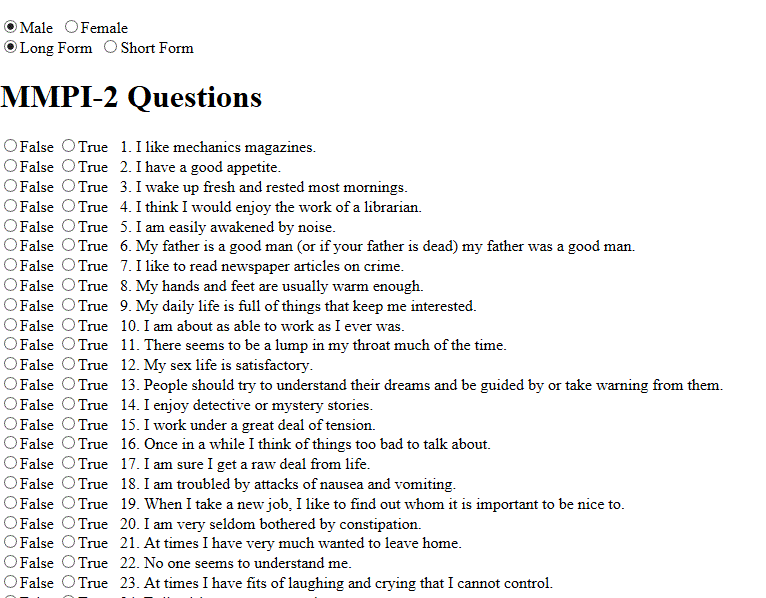
Free, web-based, modeled on MMPI-2 scales. Not the official MMPI but useful for getting a feel for the format. Results are immediate and not clinical.
3. Psychtest.net
Charges roughly $3.99 for an MMPI-2-style online assessment with self-interpretation guidance. A practice tool, not a clinical evaluation.
4. PracticeTestGeeks
Free MMPI-2 practice questions aimed at pre-employment candidates and students. Useful if you’re about to sit a real test for a job application.
5. Easy-Quizzz
Paid MMPI-style practice with quiz-style sample items, marketed at job and exam candidates.
Heads-up: None of the free or low-cost online versions are equivalent to a real MMPI-2 or MMPI-3 administered by a licensed professional. They cannot be used to diagnose mental illness. They are practice or self-assessment tools.
What the MMPI-3 measures
Validity scales (do you answer honestly?)
- VRIN-r: Variable Response Inconsistency.
- TRIN-r: True Response Inconsistency.
- F-r, Fp-r, Fs: Infrequent responses (faking bad).
- L-r: Uncommon Virtues (faking good).
- K-r: Adjustment Validity.
- RBS: Response Bias Scale.
Higher-order scales
- EID: Emotional / Internalizing Dysfunction.
- THD: Thought Dysfunction.
- BXD: Behavioral / Externalizing Dysfunction.
Substantive (clinical content) scales — examples
| Code | Scale | What it captures |
|---|---|---|
| RC1 | Somatic Complaints | Health concerns, physical symptoms |
| RC2 | Low Positive Emotions | Loss of interest, anhedonia |
| RC3 | Cynicism | Distrust of others’ motives |
| RC4 | Antisocial Behavior | Rule-breaking, conduct problems |
| RC6 | Ideas of Persecution | Paranoid ideation |
| RC7 | Dysfunctional Negative Emotions | Anxiety, irritability |
| RC8 | Aberrant Experiences | Unusual perceptions or thinking |
| RC9 | Hypomanic Activation | Elevated energy, impulsivity |
| ANX | Anxiety | Worry, tension |
| FRS | Fears | Specific and general fears |
| DEP | Depression | Low mood, hopelessness |
| OBS | Obsessiveness | Indecision, rumination |
| SUI | Suicidal/Death Ideation | Thoughts of self-harm |
| JCP | Juvenile Conduct Problems | Adolescent rule-breaking history |
| SUB | Substance Abuse | Alcohol or drug problems |
| AGG | Aggression | Verbal and physical aggression |
| FML | Family Problems | Conflict and lack of support |
| SAV | Social Avoidance | Discomfort in social settings |
| SHY | Shyness | Anxiety meeting new people |
Original MMPI-2 clinical scales (still used)
- Hs — Hypochondriasis (32 items)
- D — Depression (57 items)
- Hy — Hysteria (60 items)
- Pd — Psychopathic Deviate (50 items)
- Mf — Masculinity/Femininity (56 items)
- Pa — Paranoia (40 items)
- Pt — Psychasthenia (48 items)
- Sc — Schizophrenia (78 items)
- Ma — Hypomania (46 items)
- Si — Social Introversion (69 items)
Why people take the MMPI
- Employment screening. Federal and state law-enforcement, fire, military, and FAA pilot positions commonly require MMPI clearance.
- Court evaluations. Custody, competency, criminal responsibility, and disability claims.
- Pre-surgical screening. Bariatric, transplant, and chronic-pain candidates.
- Clinical diagnosis. A psychologist’s diagnostic workup of mental health symptoms.
- Self-knowledge. Practice versions for personal insight (not diagnosis).
How to prepare
- Sleep. Take it rested — fatigue inflates negative scales.
- Don’t try to game it. Validity scales are designed to catch faking-good and faking-bad. Inconsistent answers invalidate the report.
- Read each item. They look similar; subtle wording matters.
- Answer honestly. Skipping items piles up on the Cannot Say (?) scale.
- Plan around 50 minutes (MMPI-3) or 90 minutes (MMPI-2). Don’t start when you have to leave in 30.
FAQs
Can I take the official MMPI online for free?
No. The official MMPI-3 is owned by Pearson and only released through licensed clinicians. Free online “MMPI” tests are practice versions based on the same scales but are not the real test.
How long does the MMPI take?
MMPI-3: 35 to 50 minutes. MMPI-2: 60 to 90 minutes.
Can the MMPI diagnose me?
The test alone does not diagnose. A licensed psychologist combines results with interview, history, and other testing.
Can I fail the MMPI?
Not in the academic sense. Scores can flag concerns or invalidate the test if you answer inconsistently. For pre-employment use, a high score on certain scales can disqualify you.
How much does the MMPI cost?
$50 to $200+ through a clinician, depending on whether interpretation and a written report are included. Some employers and courts cover the fee.
Is the MMPI-3 better than the MMPI-2?
It’s shorter, has updated norms, and reflects current psychometric research. Many forensic and pre-employment evaluators still use the MMPI-2 because of established legal precedent and decades of supporting studies.
Can I retake the test?
Yes, but Pearson recommends a minimum interval to avoid practice effects and validity flags — typically several months between administrations.
What’s the difference between MMPI and MMPI-A?
MMPI-A is the adolescent version (ages 14–18). MMPI-3 and MMPI-2 are for adults 18 and older.
If you’re taking an MMPI for a job, court matter, or clinical evaluation, work with a licensed psychologist. Practice tests online can help you get used to the format, but they don’t replace a real assessment.
Leave a Reply