Porcupines cannot shoot their quills. No species, anywhere, fires quills like darts. The quills detach on contact — when a predator (or curious pet) touches a raised quill, the barbed tip lodges in skin and the quill pulls free from the porcupine. That is the entire mechanism. Below: how the defense actually works, where the shooting myth came from, and what to do if you ever end up on the receiving end.
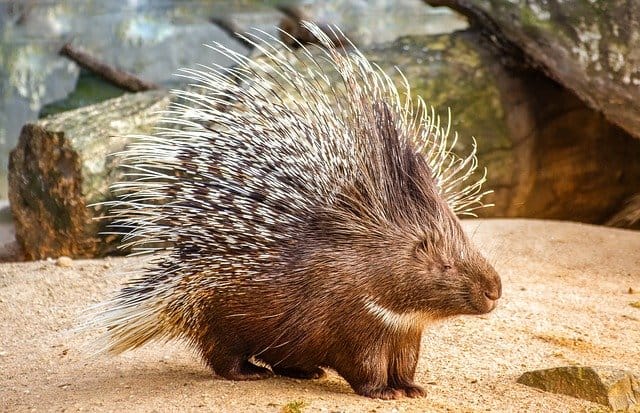
The short answer
No. Wildlife biologists at Mass Audubon, the Smithsonian’s National Zoo, and the Alaska Wildlife Conservation Center are clear on this: a porcupine has no muscle, no spring mechanism, and no projectile system that could launch a quill. The quill goes from porcupine to predator only through direct contact.
How porcupine quills actually work
A porcupine quill is a stiff, hollow hair with a needle-sharp tip. The North American porcupine carries about 30,000 of them across its back, sides, and tail.
- Loose attachment. Each quill sits lightly in the skin. A small contact pulls it out of the porcupine.
- Backward-facing barbs. The tip is covered in microscopic, fishhook-style barbs. Once embedded, those barbs grip flesh and resist removal.
- Self-burrowing. Body movement, including the breathing of the animal that got quilled, can drive the quill deeper at roughly 1 mm per hour if it is not pulled out.
- Tail whip. When threatened, the porcupine raises its quills using small muscles called arrector pili, turns its back, and lashes its tail at the threat. Quills only fly if the tail strikes something — they don’t fire on their own.
Where the “shooting” myth comes from
People watch a porcupine swing its tail and see quills go airborne. The brain fills in the rest. Three things happen at once that make it look like firing:
- An aggressive tail flick can fling a few loose quills several feet through the air.
- Porcupines molt regularly, and shed quills can be found on trails, dens, and at feeding sites.
- Hikers and dogs are sometimes quilled in places they don’t remember touching the animal — usually because contact was glancing or hidden by fur.
None of those are projectile defense. They are loose quills, dropped quills, and brief contacts.
What porcupines actually do when threatened
The defense routine is consistent across species:
- Warning. The porcupine raises its quills, clatters its teeth, and releases a strong odor from a patch of skin on its lower back.
- Turn the back. Quills are densest along the back and tail. The face and belly have soft fur and almost no quills.
- Tail strike. If the predator presses in, the porcupine drives its tail into the attacker. The barbed quills lodge and detach.
- Retreat. The porcupine moves off — slowly. They are not built for speed.
That is enough to discourage almost every predator. Fishers, mountain lions, and great horned owls have learned to flip the porcupine onto its back and attack the unprotected belly. Most other predators give up.
What to do if you (or your dog) get quilled
Embedded quills are a medical issue. They can migrate, infect, and reach internal organs.
- For a person: wash the area, then have a clinician remove the quills. Pulling barbed quills can break them, leaving fragments under the skin.
- For a dog or cat: go to a vet. Many quillings need sedation. Do not cut the quill ends — the old advice that this “deflates” them is a myth.
- Check everywhere. Inside the mouth, between the toes, on the chest. Quills hide.
- Don’t wait. Quills can migrate inward within hours.
Quick facts about porcupines
| Fact | Detail |
|---|---|
| Quills per North American porcupine | ~30,000 |
| Quill length | 1–4 inches |
| Quill makeup | Modified hair (keratin), hollow, barbed tip |
| Can shoot quills? | No |
| Lifespan in wild | 5–7 years (up to ~18 in captivity) |
| Diet | Bark, twigs, leaves, buds, fruit |
| Range | North/South America, Africa, southern Europe, Asia |
FAQs
Can a porcupine shoot a quill at all?
No. A whipping tail can throw a few loose quills a short distance, but that is mechanical fling, not aimed projectile fire.
Are porcupines dangerous to humans?
Only if you touch one. They are not aggressive, do not chase, and do not bite people in normal encounters. Stay a few feet away and a porcupine will ignore you.
Are porcupine quills poisonous?
No. They are not venomous. The danger is mechanical: barbs that resist removal and migrate through tissue, plus secondary infection from skin bacteria.
Why does my dog keep getting quilled?
Dogs charge porcupines. The porcupine turns and tail-strikes. Most dogs do not learn from one incident — many vets see the same dog quilled multiple times.
Do porcupine quills grow back?
Yes. Lost quills regrow over weeks to months, like hair. Losing quills doesn’t harm the animal.
Can you cut the end of a quill before pulling it out?
Don’t. The “release the air” trick is a myth — quills aren’t pneumatic. Cutting them makes the shaft brittle and harder to remove cleanly. Use pliers and pull straight out, or get a vet/clinician.
What predators eat porcupines?
Fishers are the specialists — they flip the porcupine and attack the belly. Mountain lions, great horned owls, bobcats, and coyotes also take them occasionally.
Are New World and Old World porcupines the same?
They are not closely related. New World porcupines (Americas) climb trees and have shorter quills. Old World porcupines (Africa, Asia, southern Europe) are ground-dwelling with much longer, more dramatic quills. Neither group can shoot quills.
You may also like: Fattest man in the world
Leave a Reply