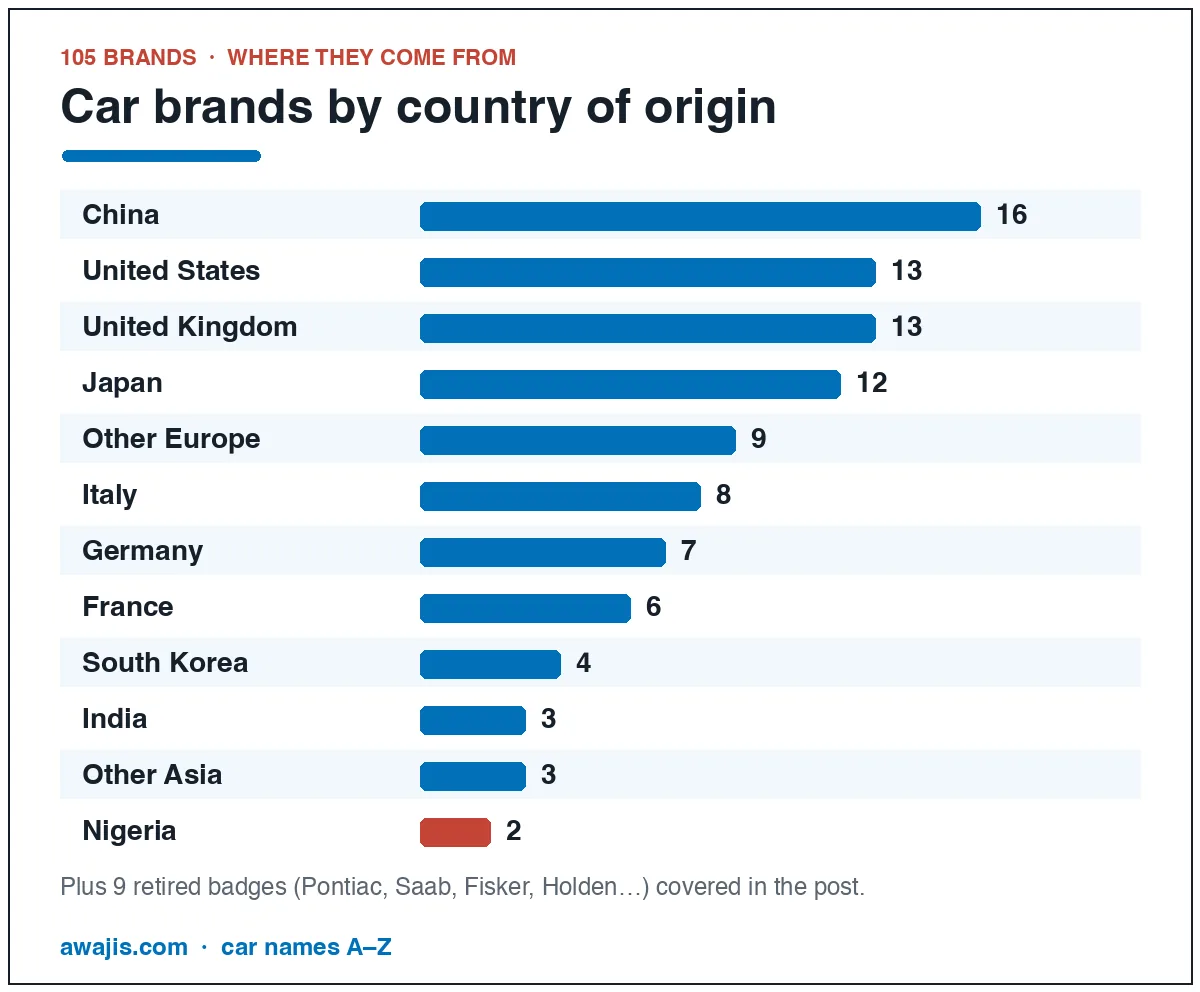
An A–Z guide to 105 car brands sold worldwide, grouped by country of origin, with parent company and what each brand is known for. Use this list to tell brands from body types (Jeep is a brand; SUV is a body type), spot the new electric players, and see which old names are gone for good.
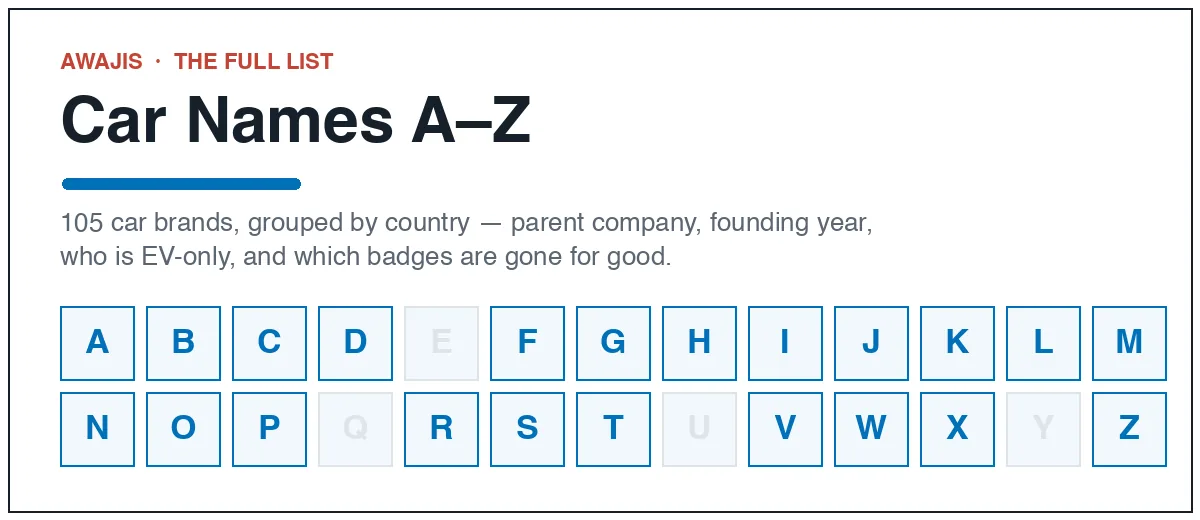
Car Brands A–Z
Every brand covered on this page, in alphabetical order. Jump to the country sections below for the parent group, founding year and what each brand is known for.
| Letter | Brands |
|---|---|
| A | Abarth, Acura, Alfa Romeo, Alpine, Aston Martin, Audi |
| B | Bentley, BMW, Bugatti, Buick, BYD |
| C | Cadillac, Caterham, Changan, Chery, Chevrolet, Chrysler, Citroën, Cupra |
| D | Dacia, Daihatsu, Denza, Dodge, DS Automobiles |
| F | Ferrari, Fiat, Fisker†, Ford |
| G | Geely, Genesis, GMC, Great Wall (GWM) |
| H | Haval, Holden†, Honda, Hongqi, Hummer†, Hyundai |
| I | Ineos, Infiniti, Innoson (IVM), Isuzu |
| J | Jaguar, Jeep |
| K | KGM (SsangYong), Kia, Koenigsegg |
| L | Lada, Lamborghini, Lancia, Land Rover, Leapmotor, Lexus, Lincoln, Lotus, Lucid, Lynk & Co |
| M | Mahindra, Maruti Suzuki, Maserati, Mazda, McLaren, Mercedes-Benz, Mercury†, MG, Mini, Mitsubishi, Morgan |
| N | NIO, Nissan, Nord |
| O | Opel |
| P | Pagani, Perodua, Peugeot, Polestar, Pontiac†, Porsche, Proton |
| R | Ram, Renault, Rimac, Rivian, Rolls-Royce |
| S | Saab†, SAIC, Saturn†, Scion†, SEAT, Škoda, Smart, Subaru, Suzuki |
| T | Tata Motors, Tesla, Toyota |
| V | Vauxhall, VinFast, Volkswagen, Volvo |
| W | Wiesmann, Wuling |
| X | Xiaomi, XPeng |
| Z | Zeekr |
That is 105 brands. A dagger (†) marks a badge that no longer builds cars — see Brands That Are Gone further down.
What Counts as a Car Brand
A brand is the badge on the boot. Many brands sit inside a parent group. Toyota and Lexus both belong to Toyota Motor Corporation. Audi, Porsche, Bentley, and Lamborghini all sit inside the Volkswagen Group, while Bugatti moved from VW to the Bugatti Rimac joint venture in 2021. Knowing the parent helps you make sense of platforms, recalls, and warranty work.
American Car Brands
The United States is home to the “Big Three” (GM, Ford, Stellantis North America) plus a wave of EV-only startups.
- Buick — General Motors, founded 1903. Mid-priced sedans and SUVs; a top seller in China.
- Cadillac — General Motors, 1902. GM’s luxury brand, now pivoting to electric with the Lyriq and Escalade IQ.
- Chevrolet — General Motors, 1911. America’s volume brand: Silverado pickups, Corvette, Equinox.
- Chrysler — Stellantis, 1925. Pacifica minivan is the main model; brand is being repositioned toward EVs.
- Dodge — Stellantis, 1900. Muscle cars (Charger, Challenger) and the Hornet crossover.
- Ford — Ford Motor Co., 1903. F-150 pickup, Mustang, and the Mustang Mach-E EV.
- GMC — General Motors, 1911. Trucks and SUVs aimed at the premium end of the truck market. Hosts the Hummer EV model line.
- Jeep — Stellantis, 1943. Off-road SUVs: Wrangler, Grand Cherokee, Wagoneer.
- Lincoln — Ford Motor Co., 1917. Ford’s luxury brand; mostly large SUVs (Navigator, Aviator).
- Ram — Stellantis, 2010. Spun out of Dodge; focuses on full-size pickups.
German Car Brands
Germany hosts 121 car companies and the world’s strongest concentration of luxury makers.
- Audi — Volkswagen Group, 1909. Quattro all-wheel drive, e-tron EV range.
- BMW — BMW Group, 1916. Sport sedans and SUVs; “Ultimate Driving Machine” tagline.
- Mercedes-Benz — Mercedes-Benz Group, 1926. The S-Class sets the luxury sedan benchmark; EQ line covers EVs.
- Opel — Stellantis, 1862. Mainstream European brand sold in the UK as Vauxhall.
- Porsche — Volkswagen Group, 1931. 911 sports car, Cayenne SUV, Taycan EV.
- Smart — Mercedes-Benz + Geely joint venture, 1994. Pivoted to electric crossovers built in China.
- Volkswagen — Volkswagen Group, 1937. Golf, Tiguan, ID.4 EV. The world’s second-largest auto group.
Japanese Car Brands
Japan leads on reliability rankings and hybrid technology.
- Acura — Honda, 1986. Honda’s premium brand for North America.
- Daihatsu — Toyota Group, 1907. One of Japan’s oldest carmakers; kei cars and compacts, big in Japan and Indonesia.
- Honda — Honda Motor Co., 1948. Civic, Accord, CR-V; also the world’s biggest engine maker (cars + motorcycles).
- Infiniti — Nissan, 1989. Nissan’s luxury brand for North American and Middle Eastern markets.
- Isuzu — Isuzu Motors, 1916. Diesel pickups and commercial trucks; pulled out of US passenger cars in 2009.
- Lexus — Toyota Motor Corp., 1989. Toyota’s luxury brand. Topped J.D. Power’s Vehicle Dependability Study four years running.
- Mazda — Mazda Motor Corp., 1920. SkyActiv engines, MX-5 Miata roadster.
- Mitsubishi — Mitsubishi Motors (Renault-Nissan-Mitsubishi alliance), 1917. Outlander PHEV, Triton pickup.
- Nissan — Nissan Motor Co., 1933. Leaf (one of the first mass-market EVs), Patrol SUV, GT-R.
- Subaru — Subaru Corp., 1953. Boxer engines and standard all-wheel drive.
- Suzuki — Suzuki Motor Corp., 1909. Small cars and SUVs; dominant in India through the Maruti Suzuki joint venture.
- Toyota — Toyota Motor Corp., 1937. The world’s top-selling brand; Corolla, RAV4, Hilux, Prius hybrid.
Korean Car Brands
South Korea’s Hyundai Motor Group is the world’s third-largest auto group.
- Genesis — Hyundai Motor Group, 2015. Hyundai’s luxury brand; G70, G80, GV80 SUV.
- Hyundai — Hyundai Motor Group, 1967. Tucson, Santa Fe, Ioniq 5 EV.
- Kia — Hyundai Motor Group, 1944. Sportage, Telluride, EV6.
- KGM (SsangYong) — KG Group, 1954. Renamed from SsangYong to KG Mobility in 2023; Torres and Rexton SUVs.
British Car Brands
The UK is now mostly home to luxury and sports nameplates owned by foreign groups.
- Aston Martin — Aston Martin Lagonda, 1913. James Bond’s brand; DB12 GT, DBX SUV.
- Bentley — Volkswagen Group, 1919. Continental GT, Bentayga SUV.
- Caterham — VT Holdings (Japan), 1973. Builds the featherweight Seven sports car, little changed since Lotus designed it.
- Ineos — Ineos Automotive, 2017. The Grenadier 4×4 and Quartermaster pickup, built for old-school off-roading.
- Jaguar — Tata Motors (JLR), 1922. Relaunching as an EV-only brand in 2026.
- Land Rover — Tata Motors (JLR), 1948. Range Rover, Defender, Discovery.
- Lotus — Geely, 1952. Lightweight sports cars; now also the Eletre electric SUV.
- McLaren — McLaren Group, 1985. Carbon-tub supercars: Artura, 750S.
- MG — SAIC Motor (China), 1924. Heritage British badge now used on affordable Chinese-built EVs and crossovers.
- Mini — BMW Group, 1959 (revived 2001). Cooper hatch and the Countryman crossover.
- Morgan — Morgan Motor Company, 1910. Hand-built, wood-framed sports cars; Plus Four and Plus Six.
- Rolls-Royce — BMW Group, 1904. Phantom, Ghost, Spectre EV.
- Vauxhall — Stellantis, 1857 (cars from 1903). Opel’s British twin; Corsa and Astra.
Italian Car Brands
Italy gave the world the supercar.
- Abarth — Stellantis, 1949. Hot-hatch tuner brand built on the Fiat 500.
- Alfa Romeo — Stellantis, 1910. Giulia sedan, Stelvio SUV, Tonale crossover.
- Ferrari — Ferrari N.V., 1939. Spun off from Fiat in 2016; F8, SF90, Purosangue SUV.
- Fiat — Stellantis, 1899. 500 city car; backbone of Italian motoring.
- Lamborghini — Volkswagen Group (Audi), 1963. Huracán, Revuelto V12 hybrid, Urus SUV.
- Lancia — Stellantis, 1906. Sold one model (Ypsilon) in Italy; new EV models began rolling out in 2024.
- Maserati — Stellantis, 1914. GranTurismo, MC20, Grecale.
- Pagani — independent, 1992. Hand-built hypercars: Huayra, Utopia.
French Car Brands
- Bugatti — Bugatti Rimac (Rimac Group + Porsche), 1909. Built in Molsheim, France; Chiron and the Tourbillon hybrid hypercar.
- Citroën — Stellantis, 1919. Comfort-tuned suspension; the budget Ami quadricycle.
- DS Automobiles — Stellantis, 2014. Stellantis’s premium French brand; spun off from Citroën.
- Peugeot — Stellantis, 1810. The 208, 3008, and 5008 are pillars of European sales.
- Renault — Renault Group, 1899. Clio, Mégane E-Tech EV, the Dacia and Alpine sub-brands.
- Alpine — Renault Group, 1955. Renault’s sports brand; A110.
Swedish Car Brands
- Polestar — Geely + Volvo, 1996. EV-only spin-off of Volvo’s performance arm.
- Volvo — Geely, 1927. Safety-first SUVs (XC60, XC90) and a fully electric line by 2030.
- Koenigsegg — independent, 1994. Hand-built hypercars (Jesko, Gemera).
Other European Brands
- Cupra — Volkswagen Group (SEAT), Spain, 2018. Sporty spin-off of SEAT.
- Dacia — Renault Group, Romania, 1966. Budget brand; the Sandero is Europe’s cheapest new car.
- Lada — AvtoVAZ, Russia, 1966. Niva off-roader and Granta sedan; Renault sold its stake in 2022.
- Rimac — Rimac Group, Croatia, 2009. Nevera electric hypercar; also co-owns Bugatti.
- SEAT — Volkswagen Group, Spain, 1950. Spanish-flavoured VW twins.
- Škoda — Volkswagen Group, Czech Republic, 1895. Practical, well-equipped family cars.
Chinese Car Brands
China has 149 carmakers and now leads the world in vehicle production. The brands below are the ones you will see exported globally.
- BYD — BYD Auto, 1995 (cars from 2003). Builds its own batteries; surpassed Tesla in global EV sales.
- Changan — state-owned, one of China’s “Big Four” automakers, building cars since 1984. Exports widely, including Africa.
- Chery — Chery Holding, 1997. Tiggo SUVs sold across emerging markets; Omoda and Jaecoo sub-brands launching in Europe.
- Denza — 2010, founded as a BYD–Mercedes joint venture; now BYD’s premium brand.
- Geely — Geely Holding, 1986. The parent of Volvo, Polestar, Lotus, and Zeekr; also sells its own Geely-badged cars.
- Great Wall (GWM) — Great Wall Motors, 1984. Pickups (Wingle, Cannon) and Haval SUVs.
- Haval — Great Wall Motors, 2013. GWM’s SUV brand; the H6 is one of China’s best-selling crossovers.
- Hongqi — FAW Group, 1958. China’s oldest passenger-car badge; state limousines turned luxury sedans and SUVs.
- Leapmotor — 2015. Stellantis holds about a fifth of the company and sells its C10 SUV and T03 city car internationally.
- Lynk & Co — Geely + Volvo, 2016. Subscription-friendly crossovers, sold in Europe and China.
- SAIC — state-owned, 1955. Owns MG and Maxus; partners with VW and GM in China.
- Wuling — SAIC-GM-Wuling, 2002. The Hongguang Mini EV is China’s best-selling tiny electric car.
- Xiaomi — Xiaomi EV, 2021. The phone maker turned carmaker; SU7 sedan and YU7 SUV.
Indian Car Brands
- Tata Motors — Tata Group, 1945. Owns Jaguar Land Rover; sells Tata-badged cars (Nexon, Punch) in India and emerging markets.
- Mahindra — Mahindra Group, 1945. SUVs and pickups; the Thar is a Wrangler-style off-roader.
- Maruti Suzuki — Suzuki + Maruti, 1981. India’s biggest carmaker by far; Swift, Baleno, Brezza.
Nigerian Car Brands
Nigeria has its own badges, built and assembled at home.
- Innoson (IVM) — Innoson Vehicle Manufacturing, Nnewi, 2007. Nigeria’s first indigenous carmaker; Caris sedan, G5T and G6T SUVs, Uzo buses. Leads local assembly sales in 2026.
- Nord — Nord Automobiles, Lagos, 2018. A5 and A9 SUVs plus the Tank and Max pickups, priced to compete with Chinese imports.
Other Asian Brands
- VinFast — Vingroup, Vietnam, 2017. Went EV-only in 2022; VF 8 and VF 9 SUVs, expanding across Asia and North America.
- Proton — Malaysia, 1983. Part-owned by Geely; Saga sedan and X70 SUV.
- Perodua — Malaysia, 1993. Daihatsu-Toyota partner; Malaysia’s best-selling brand (Myvi, Axia).
EV-Only Car Brands in 2026
A new category of brands sells nothing but battery-electric vehicles. Three of them — Tesla, Rivian, and Lucid — are independent of any legacy auto group.
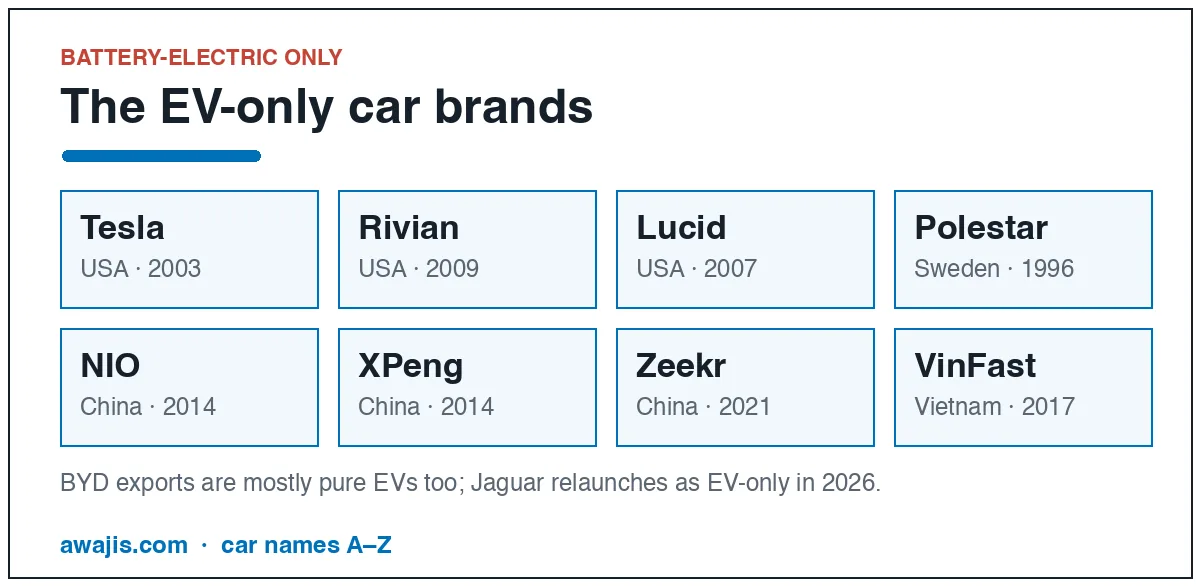
- Tesla — USA, 2003. Model 3, Model Y, Cybertruck. Reclaimed top global EV sales position in early 2026 after a year of growth.
- Rivian — USA, 2009. R1T pickup, R1S SUV, plus Amazon delivery vans.
- Lucid — USA, 2007. Lucid Air sedan, Gravity SUV; right-hand drive UK launch confirmed for late 2026.
- Polestar — Sweden (Geely + Volvo), 1996. Polestar 2 sedan, Polestar 4 coupe-SUV.
- NIO — China, 2014. Premium sedans and SUVs; pioneered battery-swap stations. Bringing the Firefly hatchback to the UK to take on the Mini.
- XPeng — China, 2014. Smart EVs with advanced driver assistance and AI features.
- Zeekr — China (Geely), 2021. Premium EVs; ranked 3rd in global EV brand sales in January 2026.
- VinFast — Vietnam (Vingroup), 2017. Dropped petrol cars in 2022; VF 8 and VF 9 SUVs.
- BYD — listed under Chinese brands but most exports are pure EVs (Atto 3, Seal, Dolphin).
- Lucid, Rivian, and Tesla are the only major automakers operating without parent-company oversight.
Brands That Are Gone
A few names in older lists are no longer making cars. If you see them on a used lot, they are second-hand only.
- Hummer — original brand discontinued by GM in 2010. The name returned in 2021 as a model line under GMC (Hummer EV pickup and SUV), not as a stand-alone brand. Source
- Mercury — Ford shut Mercury in 2011 after 72 years.
- Pontiac — GM ended Pontiac in 2010 during its bankruptcy restructuring.
- Saturn — closed by GM in 2010.
- Saab — went bankrupt in 2011. A Chinese-backed effort under NEVS failed to revive the badge.
- Scion — Toyota’s youth brand folded back into Toyota in 2016 after about 1 million cars.
- Holden — GM retired its Australian brand in 2020 after 160 years of the Holden name.
- Fisker — EV startup went bankrupt in June 2024, leaving Ocean SUV owners without factory support.
- Wiesmann — German sports-car maker filed for insolvency in 2014. A new electric Project Thunderball was unveiled in 2022 but production has been delayed.
Most Reliable Car Brands
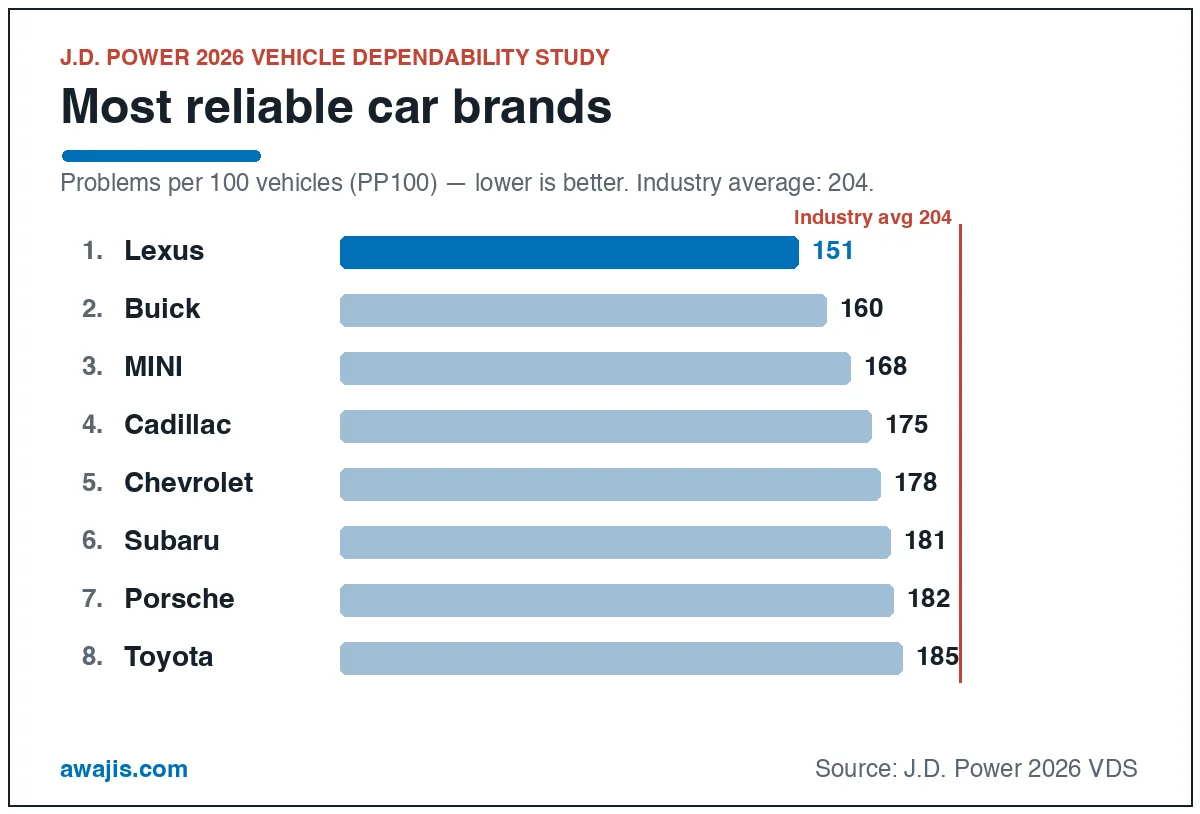
The 2026 J.D. Power U.S. Vehicle Dependability Study measures problems per 100 vehicles (PP100) reported by owners of 3-year-old cars. Lower is better. The industry average is 204 PP100, two points worse than 2025. Source: J.D. Power 2026 VDS
| Rank | Brand | PP100 | Segment |
|---|---|---|---|
| 1 | Lexus | 151 | Premium |
| 2 | Buick | 160 | Mass market |
| 3 | MINI | 168 | Mass market |
| 4 | Cadillac | 175 | Premium |
| 5 | Chevrolet | 178 | Mass market |
| 6 | Subaru | 181 | Mass market |
| 7 | Porsche | 182 | Premium |
| 8 | Toyota | 185 | Mass market |
Lexus has topped the premium segment four years running and Buick the mass market for two. Infotainment is the worst category across the industry at 56.7 PP100. Premium cars now score worse than mass-market ones (217 vs 200 PP100) because they carry more screens and electronics.
Top Global Car Groups by Sales
At the parent-company level, the 2026 picture from Focus2Move puts Toyota Group on top with about 13.4% of global market share, Volkswagen Group second at about 10%, and Hyundai-Kia third at about 8.9%. Source
- Toyota Group — Toyota, Lexus, Daihatsu, Hino
- Volkswagen Group — VW, Audi, Porsche, Škoda, SEAT, Cupra, Lamborghini, Bentley
- Hyundai-Kia — Hyundai, Kia, Genesis
- Stellantis — Jeep, Ram, Dodge, Chrysler, Fiat, Peugeot, Citroën, Opel, Vauxhall, DS, Maserati, Alfa Romeo, Lancia, Abarth
- Renault-Nissan-Mitsubishi alliance
- General Motors — Chevrolet, GMC, Buick, Cadillac, BrightDrop
- Ford Motor Company — Ford, Lincoln
- BYD — fastest-growing EV maker
- Tesla — leader in pure-electric volume in the West
American Car Brands Sold in Nigeria
American badges you will see on Lagos and Abuja roads, mostly imported as used or via Tokunbo dealerships:
- Ford
- Chevrolet
- Chrysler
- Cadillac
- Dodge
- Jeep
- Ram
- Lincoln
- Buick
- GMC
- Tesla (rising; Model Y and Model 3 most spotted)
Also Read: Price of Keke Napep in Nigeria
Car Body Types Explained
A brand is who built the car. A body type is the shape. Most brands sell cars across several body types.
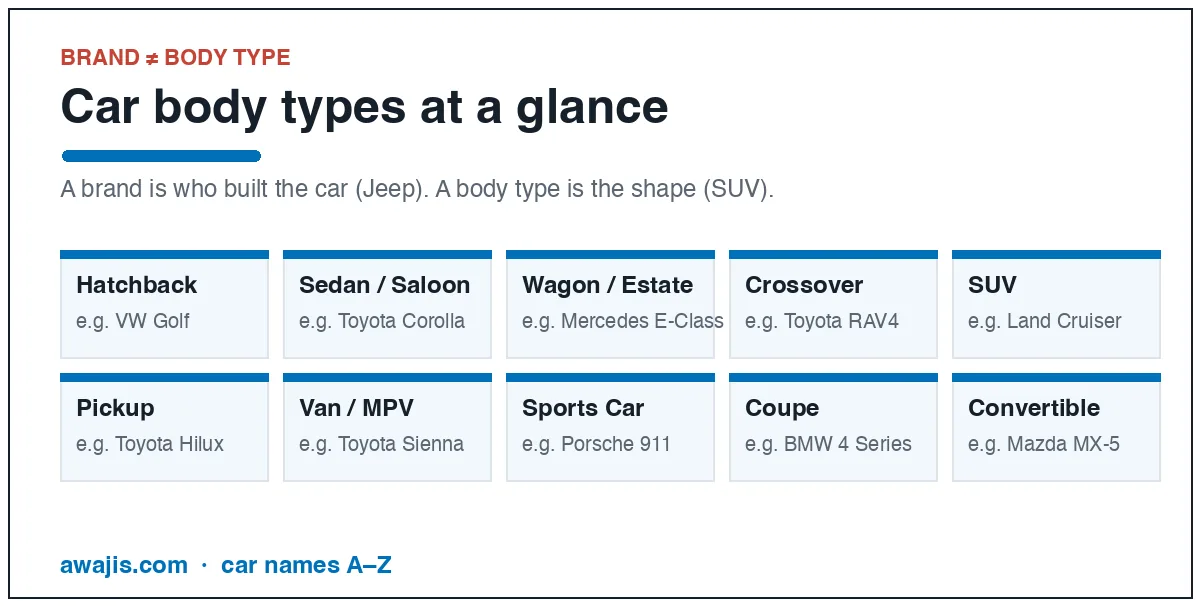
- Hatchback — short rear with a lift-up boot (e.g. Honda Jazz, VW Golf).
- Sedan / Saloon — three-box shape with a separate boot (e.g. Toyota Corolla, Honda Civic).
- Wagon / Estate — sedan stretched at the back for extra cargo (e.g. Mercedes E-Class Estate).
- Crossover — SUV-styled body on a car platform (e.g. Toyota RAV4, Hyundai Creta).
- SUV — taller, larger, often with body-on-frame and 4WD (e.g. Toyota Land Cruiser, Range Rover).
- Pickup Truck — open cargo bed at the rear (e.g. Toyota Hilux, Ford Ranger).
- Van / MPV — tall body for people-moving (e.g. Toyota Sienna, Hyundai H1).
- Sports Car — two-door, performance-tuned (e.g. Porsche 911, Mazda MX-5).
- Coupe — two-door fixed roof (e.g. BMW 4 Series Coupe).
- Convertible / Cabriolet — folding roof (e.g. Mazda MX-5 RF, Mercedes SL).
Frequently Asked Questions
How many car brands are there in the world?
There is no single official count. Wikipedia’s list of automotive marques runs into the hundreds when you include defunct, regional, and limited-production names. The major brands you can buy new in 2026 are around 70 globally; this page lists 105 including retired badges and Nigeria’s own makers.
Is Jeep a car brand or a car type?
Jeep is a brand, owned by Stellantis since 2021 (formerly under Chrysler then Fiat-Chrysler). The off-road body shape Jeep popularised is called an SUV.
Who owns the most car brands?
Stellantis owns the most badges — 14 across Europe and North America, including Jeep, Ram, Peugeot, Citroën, Fiat, and Maserati. Volkswagen Group is next with about 10 brands.
What is the best-selling car brand in the world?
Toyota is the world’s top-selling individual brand. Toyota Group also leads at the parent-company level with about 13.4% global market share.
Which car brand is most reliable?
Lexus, for the fourth year running in J.D. Power’s 2026 Vehicle Dependability Study. Buick is best among mass-market brands.
What are the new Chinese car brands?
The most visible globally are BYD, Geely (parent of Volvo, Polestar, Lotus, Zeekr), Chery, Great Wall (GWM), NIO, XPeng, Xiaomi, and SAIC’s MG.
Which car brands are EV-only?
Tesla, Rivian, Lucid, Polestar, NIO, XPeng, Zeekr, and VinFast build battery-electric vehicles only. Jaguar relaunches as EV-only in 2026.
Are Hummer and Saab coming back?
Hummer is back as a GMC model line (the Hummer EV), not as a stand-alone brand. Saab is not coming back — every revival attempt has failed.
What is the difference between Lexus and Toyota?
Both are made by Toyota Motor Corporation. Lexus is Toyota’s premium brand (launched 1989) with higher-grade trim, longer warranties, and dedicated dealerships.
For more on cars in Nigeria, see our guide on cost of clearing cars in Nigeria and accredited Toyota dealers in Nigeria.