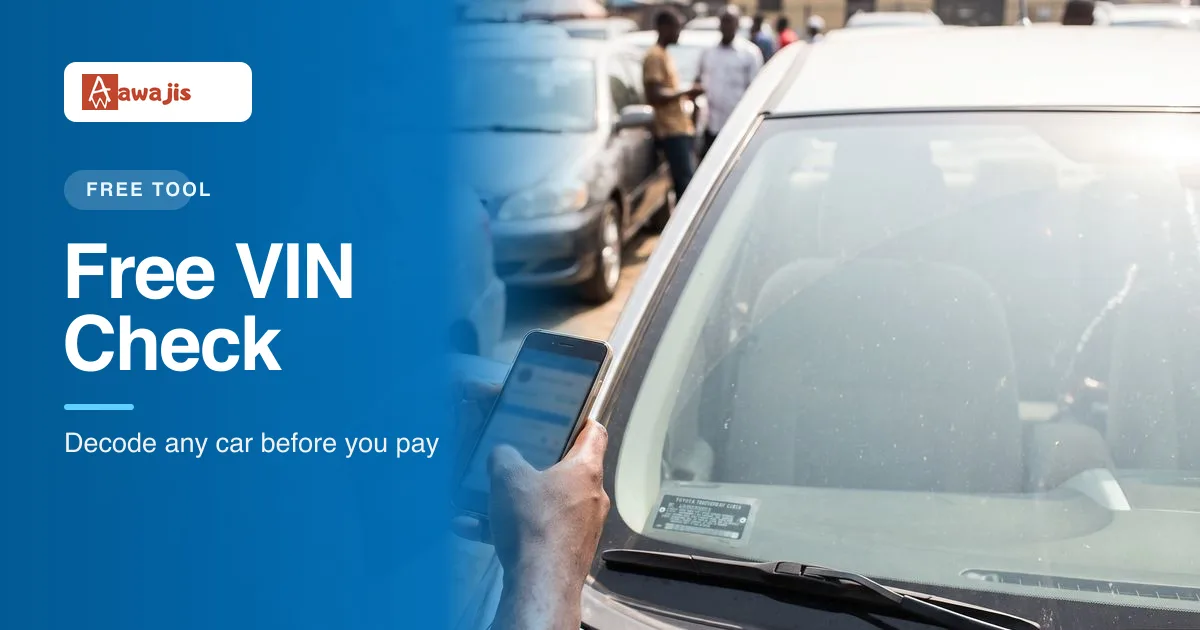
You can check any car’s VIN free, right here. Type the 17-character Vehicle Identification Number into the tool below and it pulls the factory build record — make, model, year, engine, where it was assembled — plus any safety recalls, straight from the official US government (NHTSA) database. No sign-up, no fee, and the VIN never leaves your browser.
Check any VIN free
Type the 17-character VIN from the car or its customs papers. We confirm it is a real VIN, then pull the factory build record — make, model, year, engine, where it was built — plus any open safety recalls.
The VIN is checked in your browser against the official U.S. government (NHTSA) database — we do not store it. Cars built for the American market (most tokunbo imports) decode fully; VINs from Europe or Asia may return partial details.
Where to find the VIN
Check these places — and make sure they all carry the same number:
- Dashboard plate — driver’s side, where the windscreen meets the dashboard. Read it from outside the car.
- Driver’s door jamb sticker — open the driver’s door and check the frame.
- Engine bay — stamped on the firewall or chassis on many models.
- The papers — customs documents, proof of ownership, and the vehicle licence all quote the VIN (sometimes called the chassis number).
If the plate on the car and the number on the papers don’t match character for character, walk away. That mismatch is how stolen and re-tagged vehicles get sold.
What the free check shows — and what it can’t
The free check decodes what the car left the factory as. That catches the most common tokunbo tricks:
- Year misdeclaration — a “2012” that decodes as 2008. Sellers shave years off to justify the price; the VIN doesn’t lie.
- Model and trim swaps — an LE badged and priced as an XLE.
- Fake or mistyped VINs — a VIN that fails the built-in check digit, or returns no factory record at all, deserves hard questions before any money moves.
- Open recalls — known safety faults (airbags, brakes) recorded against that model year.
What it cannot show is what happened to the car after the factory: accidents, flood damage, salvage titles, odometer rollbacks, and theft records live in paid history databases (Carfax, AutoCheck and the US NMVTIS system). If a seller claims “first body, no accident” on a clean-looking import, a paid history report is the only way to verify it.
Before you pay for any tokunbo car
- Read the VIN off the dashboard plate yourself — not from a photo the seller sends.
- Run it through the checker above. Year, make, model and engine must match what you were told.
- Compare the VIN on the plate, door jamb and customs papers. All three must agree.
- Ask for the customs duty papers and confirm the VIN on them is this car’s — duty paid on a different vehicle does not cover yours.
- Only after those pass, decide if the deal is worth a full history report for the accident and title record.
The VIN also sets your customs duty
Nigeria Customs values imported vehicles through its VIN valuation system — the VIN, not your invoice, determines the dutiable value the Combined Duty Assessment is based on. As of August 2026, used passenger cars attract 20% duty plus a 5% NAC levy (cut from 15% in July 2026), 7.5% VAT and smaller levies on top. So the same VIN check that protects you from a dishonest seller also tells you the exact year Customs will value the car as — a “2008 sold as 2012” surprise at the port costs real money. If you’re budgeting an import, check the dollar to naira rate before you wire payment, and factor in today’s fuel prices when choosing an engine size.
Common questions
Is this VIN check really free?
Yes. The decode and recall data come from NHTSA, a US government agency that publishes them free. We don’t collect the VIN, your name, or anything else.
Does it work on cars imported from Europe or Asia?
Partially. The database is built around vehicles made for the American market — which covers most tokunbo imports. A Europe- or Asia-market VIN may return only the manufacturer and country, and can fail the check-digit test while still being genuine.
Can I see accident history free?
No — nobody offers genuine accident history free. Sites that promise a “free full report” either show you this same factory data or want your card details. Real accident, flood and salvage records come from paid databases only.
What if the VIN returns nothing at all?
Re-check every character first — 0 vs O and 1 vs I mistakes are common. If a supposedly American-market car still returns no record, treat it as a serious red flag.
Leave a Reply