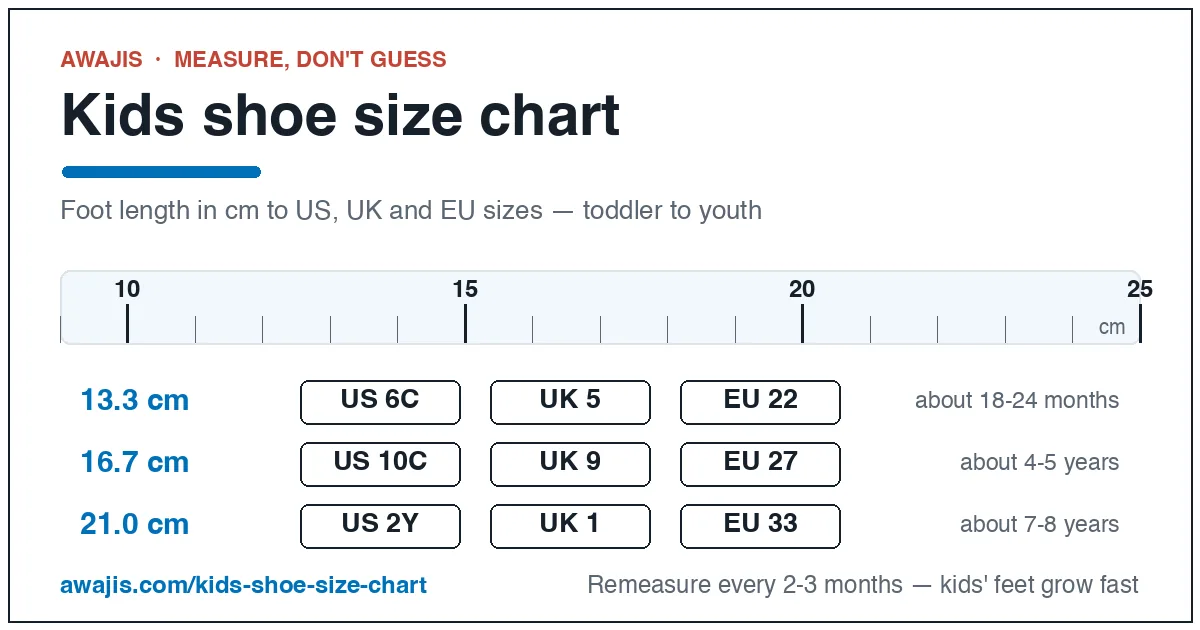
Measure your child’s foot in centimeters, then read the size off the chart — that’s the whole job. Age-based guesses fail because a size 10C fits some 3-year-olds and some 5-year-olds. Foot length is what US, UK, and EU kids’ shoe sizes are all built on.
Find the shoe size from your child's foot length
Measure heel to longest toe, then type the length. We give the US, UK, and EU size instantly.
Enter a foot length between 8 and 26 cm (3 to 10 in) and the sizes appear here.
Sizes are the size that fits that foot with toe room — we round up, never down. Nothing you type is sent anywhere.
How to measure a child’s foot
- Stand the child on a sheet of paper against a wall, heel touching the wall. Feet spread slightly, full weight on both.
- Mark the tip of the longest toe (not always the big toe).
- Measure wall-to-mark with a ruler, in centimeters.
- Measure both feet — they differ. Use the longer one.
- Add about 1 cm of toe room, or use the chart below, which already rounds up.
Measure in the afternoon; feet swell slightly through the day. Socks on if they’ll wear socks in the shoes.
Kids shoe size chart: foot length to US, UK, EU
US kids’ sizes run 1C–13C (toddler/little kid), then restart at 1Y–7Y (youth). UK kids’ sizes also restart — UK 13 is followed by UK 1. The “fits foot up to” column already includes toe room.
| Fits foot up to | US Size | UK Size | EU Size |
| 9.1 cm / 3.6 in | 1C | 0.5 | 16 |
| 10 cm / 3.9 in | 2C | 1 | 17 |
| 10.8 cm / 4.3 in | 3C | 2 | 18 |
| 11.6 cm / 4.6 in | 4C | 3 | 19 |
| 12.5 cm / 4.9 in | 5C | 4 | 20 |
| 13.3 cm / 5.2 in | 6C | 5 | 22 |
| 14.2 cm / 5.6 in | 7C | 6 | 23 |
| 15 cm / 5.9 in | 8C | 7 | 24 |
| 15.9 cm / 6.3 in | 9C | 8 | 25 |
| 16.7 cm / 6.6 in | 10C | 9 | 27 |
| 17.6 cm / 6.9 in | 11C | 10 | 28 |
| 18.4 cm / 7.2 in | 12C | 11 | 30 |
| 19.3 cm / 7.6 in | 13C | 12 | 31 |
| 20.1 cm / 7.9 in | 1Y | 13 | 32 |
| 21 cm / 8.3 in | 2Y | 1 | 33 |
| 21.8 cm / 8.6 in | 3Y | 2 | 34 |
| 22.7 cm / 8.9 in | 4Y | 3 | 36 |
| 23.5 cm / 9.3 in | 5Y | 4 | 37 |
| 24.4 cm / 9.6 in | 6Y | 5 | 38 |
| 25.2 cm / 9.9 in | 7Y | 6 | 39 |
Brands cut differently — some run a half size either way. When a brand publishes its own foot-length chart, trust that over any generic table, including this one.
EU to UK quick answers
EU kids’ shoe sizes climb one number per ~6.7 mm of foot. The pairs people search for most:
What is kids size 24 in UK?
EU 24 is UK kids 7 (US 8C) — a foot up to about 15 cm, typically age 3 to 4.
What is kids size 26 in UK?
EU 26 sits between UK 8 and 8.5 (US 9C–9.5C) — a foot around 15.5 to 16 cm, typically age 4.
What is kids size 28 in UK?
EU 28 is UK kids 10 (US 11C) — a foot up to about 17.6 cm, typically age 5 to 6.
What is kids size 30 in UK?
EU 30 is UK kids 11 (US 12C) — a foot up to about 18.4 cm, typically age 6 to 7.
What is kids size 32 in UK?
EU 32 is UK kids 13 (US 1Y) — a foot up to about 20.1 cm, typically age 7 to 8. The next size, EU 33, crosses into UK 1 youth.
Shoe size by age (rough guide only)
Use this to shortlist, never to buy:
| Age | Typical US size | Typical EU size |
| 12–18 months | 4C–5C | 19–20 |
| 18–24 months | 5C–6C | 20–22 |
| 2–3 years | 7C–8C | 23–24 |
| 4–5 years | 9C–11C | 25–28 |
| 6–7 years | 12C–13C | 30–31 |
| 8–9 years | 1Y–3Y | 32–34 |
| 10–12 years | 4Y–6Y | 36–38 |
For clothing rather than shoes, see our kids clothing size charts — clothing uses height and weight, not foot length.
FAQs
What does the C and Y mean in US kids sizes?
C = child (toddler/little kid, sizes 1C–13C). Y = youth (big kid, 1Y–7Y). After 13C the scale restarts at 1Y — a 1Y is bigger than a 13C, not smaller.
When do kids move into adult sizes?
After 7Y (foot longer than about 25.2 cm). A 7Y equals roughly a US women’s 8.5 or men’s 7; UK youth 6 leads into adult UK 6.5.
How often should I check my child’s shoe size?
Every 2–3 months under age 4, every 4 months to about age 8. A shoe is outgrown when the toe gap drops under half a centimeter.
Should I buy a size up for growing room?
Half a size up is fine. A full size up causes tripping and blisters — the foot slides. Adjustable straps and laces forgive more than slip-ons.
Leave a Reply