How much do EMTs make? EMTs earn a median of $41,340 a year, or about $19.87 an hour, according to the U.S. Bureau of Labor Statistics (May 2024). The lowest-paid 10% make under $31,410; the top 10% make over $60,780. Paramedics, who hold a higher certification, earn far more: a median of $58,410 a year (about $28.08 an hour). Pay rises with your level, your state, and your employer.
This guide breaks down EMT and paramedic pay by hour, level, state, and employer, plus the job outlook and how to earn more.
How much does an EMT make a year?
The median annual EMT wage is $41,340, or about $19.87 per hour (BLS, May 2024). “Median” means half of EMTs earn more and half earn less.
Pay spreads wide across the field:
- Bottom 10%: under $31,410 a year
- Median (50th percentile): $41,340 a year
- Top 10%: over $60,780 a year
At a 40-hour week, the median works out to roughly $795 a week or $3,445 a month before taxes. Many EMTs add overtime, night shifts, or holiday pay on top of base wages.
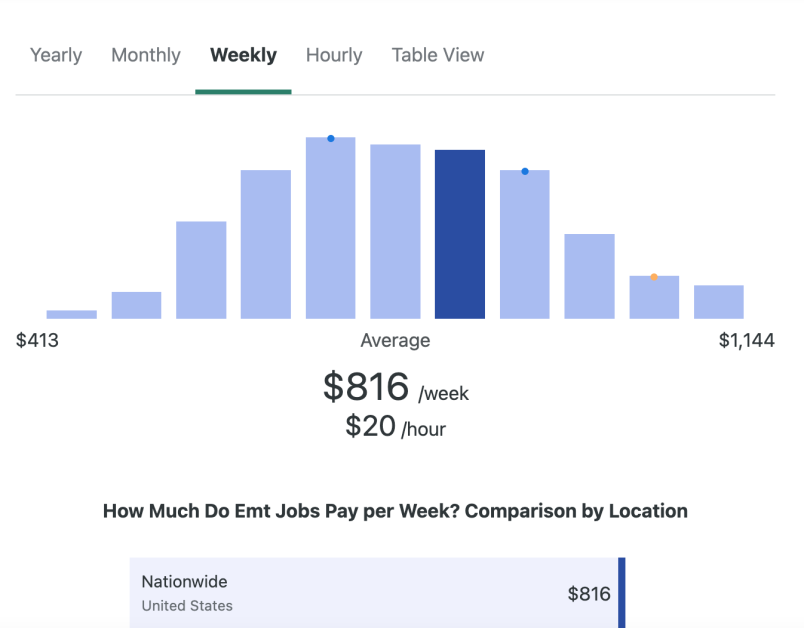
ZipRecruiter crowd-sourced weekly and hourly EMT pay, shown alongside the BLS figures. Its ~$20/hour estimate lines up with the BLS median of $19.87.
Source: U.S. Bureau of Labor Statistics, EMTs and Paramedics.
What factors change how much an EMT makes?
Your pay depends on:
- Certification level — Paramedics out-earn EMTs by about $17,000 a year (more on this below)
- Location — State and city wages vary widely
- Employer type — Fire departments and government agencies tend to pay more than private ambulance services
- Experience — Years on the job move you up the pay scale
- Extra skills and shifts — Special certifications and overtime raise your take-home pay
Related: How much does TikTok pay you for 1 million views? (2025 Report)
EMT vs. Paramedic: what’s the pay difference?
A paramedic’s median pay is $58,410 a year (about $28.08 an hour) versus $41,340 for an EMT. That’s a gap of about $17,000 a year for the same field.
The reason is scope and training. EMTs complete a state-approved course (often a few hundred hours) and provide basic life support. Paramedics finish a longer program (often 1,200 to 1,800 hours, sometimes an associate degree) and provide advanced care like IV lines, airway management, and cardiac drugs.
Paramedic pay also spreads wider:
- Bottom 10%: under $40,130 a year
- Median: $58,410 a year
- Top 10%: over $82,420 a year
If you want the fastest pay raise as an EMT, advancing to paramedic is the clearest path.
Source: U.S. Bureau of Labor Statistics.
How much do EMTs make by employer type?
Where you work shifts your pay as much as where you live. Government and hospital jobs usually pay more than private ambulance companies, and they often include better benefits and pensions.
Using BLS May 2024 figures, paramedics earned the most in these settings:
- Local government (excluding schools and hospitals): about $59,840 a year
- Physicians’ offices: about $59,370 a year
- General medical and surgical hospitals: about $58,780 a year
Private ambulance services employ the largest share of EMS workers but tend to sit at the lower end of the pay range. Fire departments often pay well because many firefighters hold dual EMT or paramedic certification and earn on a firefighter pay scale.
Source: U.S. Bureau of Labor Statistics.
What is the job outlook for EMTs?
Employment of EMTs and paramedics is projected to grow 5% from 2024 to 2034, faster than the average for all jobs. The BLS expects about 19,000 openings each year over the decade, mostly to replace workers who retire or change careers.
An aging population drives demand: more older adults means more falls, heart attacks, and strokes that need emergency response.
Source: U.S. Bureau of Labor Statistics.
Which states pay EMTs the most?

State pay varies because of cost of living, demand, and how EMS is funded. For official, employer-reported figures by state, check the BLS state wage tables for EMTs and paramedics.
The estimates below come from ZipRecruiter and reflect crowd-sourced job postings, so they run higher than BLS medians and combine some EMT and paramedic roles. Use them as a rough guide to where pay trends higher, not as exact figures.
Higher-paying states for EMTs (estimates)
- Minnesota: $53,562 per year
- Louisiana: $51,153 per year
- Alabama: $50,032 per year
- North Dakota: $48,935 per year
- Texas: $47,869 per year
- New York: $46,849 per year
- Washington: $46,774 per year
- Nevada: $46,705 per year
- Oregon: $45,861 per year
- Maryland: $45,424 per year
Which cities pay EMTs the most?
City pay can beat the state average, but weigh it against cost of living. A higher salary in San Francisco or Washington, D.C., stretches less than a smaller one in a low-cost town.
The table below shows higher-paying cities for EMT jobs, based on ZipRecruiter’s crowd-sourced postings (treat as estimates).
| City | Annual Salary | Monthly Pay | Weekly Pay | Hourly Wage |
|---|---|---|---|---|
| Green River, WY | $49,278 | $4,106 | $947 | $23.69 |
| Atkinson, NE | $48,563 | $4,046 | $933 | $23.35 |
| San Francisco, CA | $45,469 | $3,789 | $874 | $21.86 |
| Cool Valley, MO | $45,394 | $3,782 | $872 | $21.82 |
| Bolinas, CA | $45,319 | $3,776 | $871 | $21.79 |
| Washington, DC | $45,213 | $3,767 | $869 | $21.74 |
| Los Angeles, CA | $44,569 | $3,714 | $857 | $21.43 |
| Jersey City, NJ | $44,510 | $3,709 | $855 | $21.40 |
| Brownsboro, TX | $44,485 | $3,707 | $855 | $21.39 |
| Kensington, NY | $44,397 | $3,699 | $853 | $21.34 |
Source: ZipRecruiter.com (crowd-sourced estimates)
How can an EMT earn more money?
Four moves raise your pay the most, roughly in order of payoff:
- Advance to paramedic. This is the biggest single jump — about $17,000 more a year at the median.
- Move to a higher-paying employer. Aim for fire departments, hospitals, or government EMS over private ambulance services.
- Work in a higher-wage state or metro. Compare the pay against local cost of living first.
- Add experience and overtime. Seniority, night and holiday shifts, and special certifications all add up.
Many EMTs also use the job as a stepping stone into nursing, physician assistant, or firefighter roles that pay more.
Read Also: What military branch pays the most? (2025 Review)
What does an EMT do?
An Emergency Medical Technician (EMT), also called an ambulance technician, provides emergency medical care, usually in or from an ambulance. EMTs work under protocols written by a physician.
Common duties include:
- Answer 911 emergency calls and respond on-scene
- Provide basic life support and patient care
- Transport patients to a hospital safely
- Follow infection-control procedures
- Stay on-call during shifts to respond to emergencies
- Keep the ambulance and its equipment clean and stocked
- Maintain compliance with licensing rules
Private ambulance services, municipal EMS agencies, governments, hospitals, and fire departments employ EMTs. Some are paid; others, especially in rural areas, volunteer.
Must Read: How Much Do Dallas Cowboy Cheerleaders Make?
How do you become an EMT?
To become an EMT, you must be 18 and complete a state-approved EMT course. No college degree is required, but you need a high school diploma or GED.
The steps:
- Finish a state-approved EMT training program at a community college or vocational school. Some programs require CPR certification first.
- Pass the National Registry Emergency Medical Technician (NREMT) cognitive exam.
- Obtain CPR certification from a recognized provider, such as the American Red Cross.
- Apply for your state license.
You learn the job through classroom and hands-on training, so no prior medical experience is needed.
What is the difference between an EMT and a paramedic?
EMTs and paramedics start with the same basic training. The difference is depth: paramedics train longer and treat more serious injuries and illnesses.
EMTs can perform CPR, give glucose and oxygen, and manage asthma attacks. Paramedics add advanced care, such as starting IV lines, managing airways, and supporting patients during heart attacks.
Every paramedic begins as an EMT. Many use the role as a stepping stone to nursing or other medical careers.
Compare official, current numbers any time on the BLS EMTs and Paramedics page.
Recommended:
Are Physical Therapists Doctors? (Simplified Answer 2025)
Why Do Orthopedic Surgeons Hate Podiatrists? (Top 7 Reasons)
Leave a Reply
You must be logged in to post a comment.