Tesla Powercore is not a home battery, and you cannot buy one. It is utility equipment: a solid-state transformer, inverter and circuit breaker in one enclosure, rated at 7.4 megawatts, built to connect battery farms, solar plants and AI data centers to 34.5-kilovolt power lines. Tesla unveiled it on 17 November 2026 and says it will be operating in 2027. No price has been announced. If an ad offers a plug-in “Tesla Powercore” or “Tesla Power Core” that cuts your electric bill, it is not from Tesla.
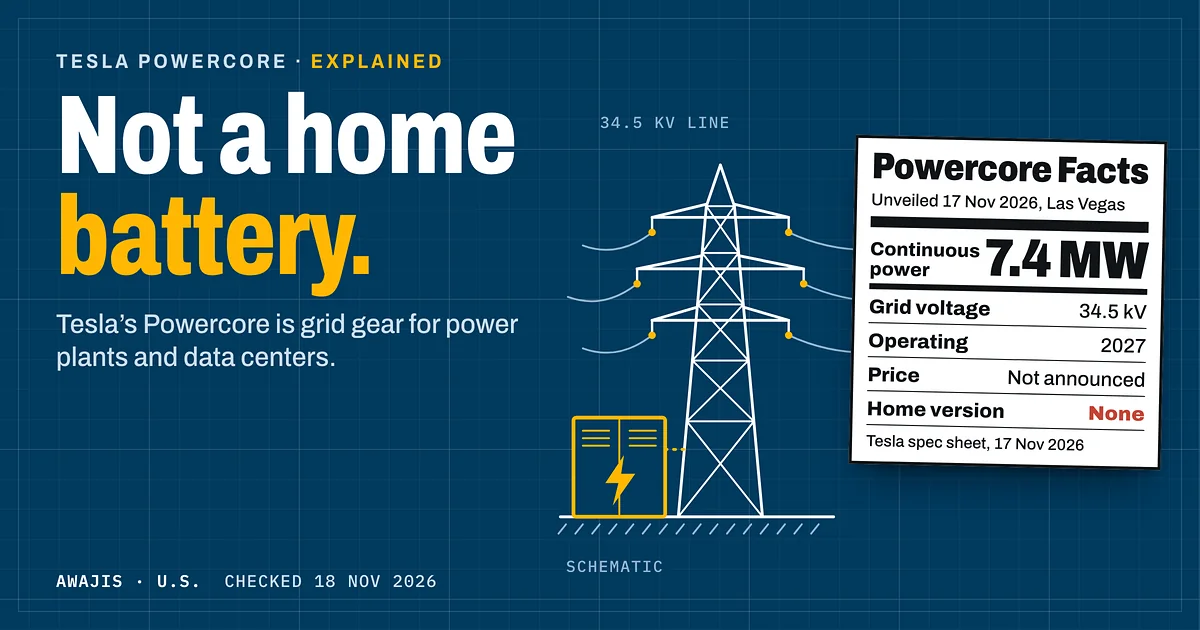
Checked on 18 November 2026 against Tesla’s 17 November announcement and spec sheet as quoted by Electrek and pv magazine USA, which interviewed Tesla’s head of energy and charging. We have not seen the unit, and the drawing above is a schematic: Tesla has not published its size or weight.
This guide covers what Powercore does, how it differs from Powerwall and Megapack, when it arrives, and how to spot gadgets that borrow the name.
Tesla Powercore at a glance
| Question | Answer |
|---|---|
| What is it? | Solid-state transformer, inverter and circuit breaker in one enclosure |
| Is it a battery? | No. It stores nothing. It converts and switches power. |
| Continuous power | 7.4 MW (9 MVA), with 10 MVA of peak grid-forming support |
| Grid side | 10 kV to 34.5 kV AC |
| Battery or solar side | 800 V to 2,000 V DC (nominal) |
| Peak efficiency | 98.86% (Tesla’s figure, not independently tested) |
| Fault shutoff | 100 microseconds |
| Operating temperature | −40°F to 131°F (−40°C to 55°C) |
| Warranty | Up to 25 years |
| Where it is made | Tesla facilities in the U.S., from U.S. and imported parts. No factory named. |
| When | Operating in 2027 |
| Price | Not announced |
| Size and weight | Not disclosed |
| Home version | None announced |
Sources: Tesla’s announcement and spec sheet as quoted by Electrek; voltage ranges, fault time, temperature and warranty from pv magazine USA.
What is Tesla Powercore?
Batteries and solar panels produce low-voltage direct current. The power lines that feed a town carry alternating current at tens of thousands of volts. Something has to convert one into the other.
Today that takes three pieces of equipment. An inverter turns DC into AC. A large oil-filled, iron-core transformer steps the voltage up. Switchgear disconnects everything when there is a fault. Powercore does all three jobs with silicon carbide electronics in a single enclosure.
Tesla says the older two-step setup in its grid batteries “had twice the losses,” according to Electrek. The same report says Powercore contains no flammable oil and that parts can be serviced on site without swapping the whole unit.
The built-in breaker is the part Tesla talks up for safety. Tesla “can interrupt faults a thousand times faster than traditional equipment,” AJ Booth, the company’s head of energy and charging, told pv magazine USA.
Tesla showed it at RE+ 2026 in the Las Vegas Convention Center. The name is one word, Powercore, although plenty of people are searching for “Tesla Power Core.”
Can you buy a Tesla Powercore for your home?
No. Three things rule it out.
- Voltage. A U.S. home runs on 120 and 240 volts. Powercore connects to lines carrying up to 34,500 volts.
- Scale. One Powercore moves 7.4 megawatts continuously. A Powerwall 3 delivers 11.5 kilowatts. By our arithmetic, that is the output of about 640 Powerwalls.
- Buyers. Tesla is pitching it for battery storage sites, solar farms and data centers. None of the coverage we read mentions a residential version.
What Tesla sells for a house is the Powerwall 3: 13.5 kilowatt-hours of storage with a built-in solar inverter. EnergySage put the typical installed cost at about $13,500 before incentives in May 2026. Prices vary by home and installer.
Powercore vs. Powerwall vs. Megapack: what is the difference?
| Product | What it is | Who buys it | Size |
|---|---|---|---|
| Powerwall 3 | Home battery with built-in inverter | Homeowners | 13.5 kWh, 11.5 kW |
| Megapack 3 | Container-size grid battery | Utilities and project developers | About 5 MWh per unit |
| Megablock | Four Megapack 3 units with a transformer and switchgear | Utilities and project developers | 20 MWh |
| Powercore | Transformer, inverter and breaker in one. Stores no energy. | Utilities, developers and data centers | 7.4 MW |
Powerwall figures are from EnergySage; Megapack 3 and Megablock figures are as reported by ESS News. Powercore is the connection between batteries like Megapack and the grid. It does not replace any of them.
Will Powercore lower your electric bill?
Not directly, and Tesla has not said it will. Powercore is equipment for the companies that build power projects.
The indirect case is about speed. Conventional transformers are in short supply, with lead times of as long as four years, pv magazine USA reports. If solid-state units let storage and solar projects connect sooner, that could ease a bottleneck on the grid. Whether any of that reaches your bill is unproven.
When will Powercore be available, and what does it cost?
Tesla’s announcement says “Made in America. Operating 2027.” The company has not shared pricing, customers or a factory location, Electrek reports.
For data centers, Powercore converts grid power to 800 volts DC for servers in one step. Tesla is working with NVIDIA to certify it for NVIDIA’s DSX Ready Program, according to pv magazine USA.
Who is Powercore competing with?
The closest rival is Heron Power, founded by Drew Baglino, who was Tesla’s senior vice president of powertrain and energy until April 2024. Its Heron Link is rated at about 5 megawatts for solar and storage. RWE has signed a pilot to install Heron Links at a Texas battery site in April 2027, with volume production planned for late 2027.
Electrek’s read: “Tesla’s specs now match or beat Heron’s on paper.” But Heron has named customers, a pilot site with a date and a factory under construction. Tesla has announced none of those for Powercore yet.
Scam watch: plug-in “Tesla Power Core” energy savers
We searched on 18 November 2026 and found no gadget sold under the Powercore name. Expect that to change. Cheap plug-in “energy savers” have borrowed Tesla’s and Elon Musk’s names for years, and a new Tesla energy product is exactly the kind of headline they follow.
Snopes found the same electricity-saving box sold as StopWatt and Pro Power Saver and “misleadingly associated with Musk, Tesla (the company), and even Nikola Tesla himself.” PolitiFact rated the claim that Musk invented a device to “cut electricity bills by 80%” Pants on Fire; the ad was selling a $49 plug called Slash Watts. Lead Stories traced a Watt Saver ad to a fake Fox News report and a made-up endorsement.
One Tesla-sounding name is already circulating. A plug-in “energy optimization device” called TeslaCare is promoted on a review-style page that names no manufacturer and sends its “official website” buttons to a third-party checkout. The page does not claim a link to Tesla, Inc., and we found none.
Why a plug-in saver cannot cut a home bill
These boxes are sold as power-factor correctors. A National Institute of Standards and Technology primer explains why that does nothing for a household: the device lowers the current you draw and raises the power factor by a matching amount, and “because a residential electric bill is proportional to this product, the cost remains unchanged.”
An electric co-op spokesperson put it more simply to Scripps News: “If there was indeed a device that you could just plug in and reduce your power bill, we would be all over it.”
Some are also unsafe. In the U.K., consumer group Which? tested eight of these plugs in 2025 and found every one failed electrical safety rules, and the product safety regulator recalled one in 2022 over a serious risk of electric shock and fire. We found no equivalent U.S. test.
Red flags to check before you pay
- Huge savings. Promises of 50% to 90% off your bill from a device that costs $40 to $50.
- A famous face. Elon Musk or a TV host shown holding or endorsing the box. The photos in past ads were doctored.
- A news story that does not exist. A page dressed up as Fox News or another outlet. Search the outlet’s own site for it.
- A countdown. “100% off ends today” banners and other pressure to order now.
- A text that knows your name. Bitdefender tracked U.S. texts that open with the recipient’s name and claim “your neighbors are saving 79%.”
- A name that keeps changing. StopWatt, Pro Power Save, Miracle Watt, Watt Saver and eSaver are the same kind of box. The brand often is not even printed on the device.
- The wrong kind of product. The real Powercore is industrial equipment. It is not sold to households at any price.
If you already paid
If you paid by credit card, the Federal Trade Commission’s advice is to “report it to the credit card issuer immediately” and ask for the charge to be reversed. For a debit card, contact your bank or credit union right away.
Then report the seller at ReportFraud.ftc.gov and on the BBB Scam Tracker. Unplug the device. Do not leave it in an outlet as a night light.
Quick answers
Is it “Tesla Power Core” or “Powercore”?
Powercore, one word. Tesla’s announcement opens with “Introducing Powercore.”
Is Powercore a battery?
No. It stores no energy. It converts and switches power between batteries, solar arrays or data centers and the grid.
Does Powercore work with Powerwall?
No. It pairs with Megapack grid batteries, large solar arrays and data centers. A Powerwall connects to your home’s electrical panel.
Has anyone bought one yet?
Tesla has not named a customer. It says units will be operating in 2027.
Sources
- Electrek, 17 November 2026: Tesla’s announcement, spec sheet and the Heron Link comparison
- pv magazine USA, 17 November 2026: interview with Tesla’s AJ Booth
- Snopes (via Yahoo), PolitiFact and Lead Stories: fact checks of Musk-branded energy savers
- NIST Technical Note 1654 summary and Science Feedback: why power-factor plugs do not cut home bills
- Scripps News and Bitdefender: U.S. ad and text campaigns
- Which?: U.K. safety tests
- FTC: What to do if you were scammed
Leave a Reply
You must be logged in to post a comment.